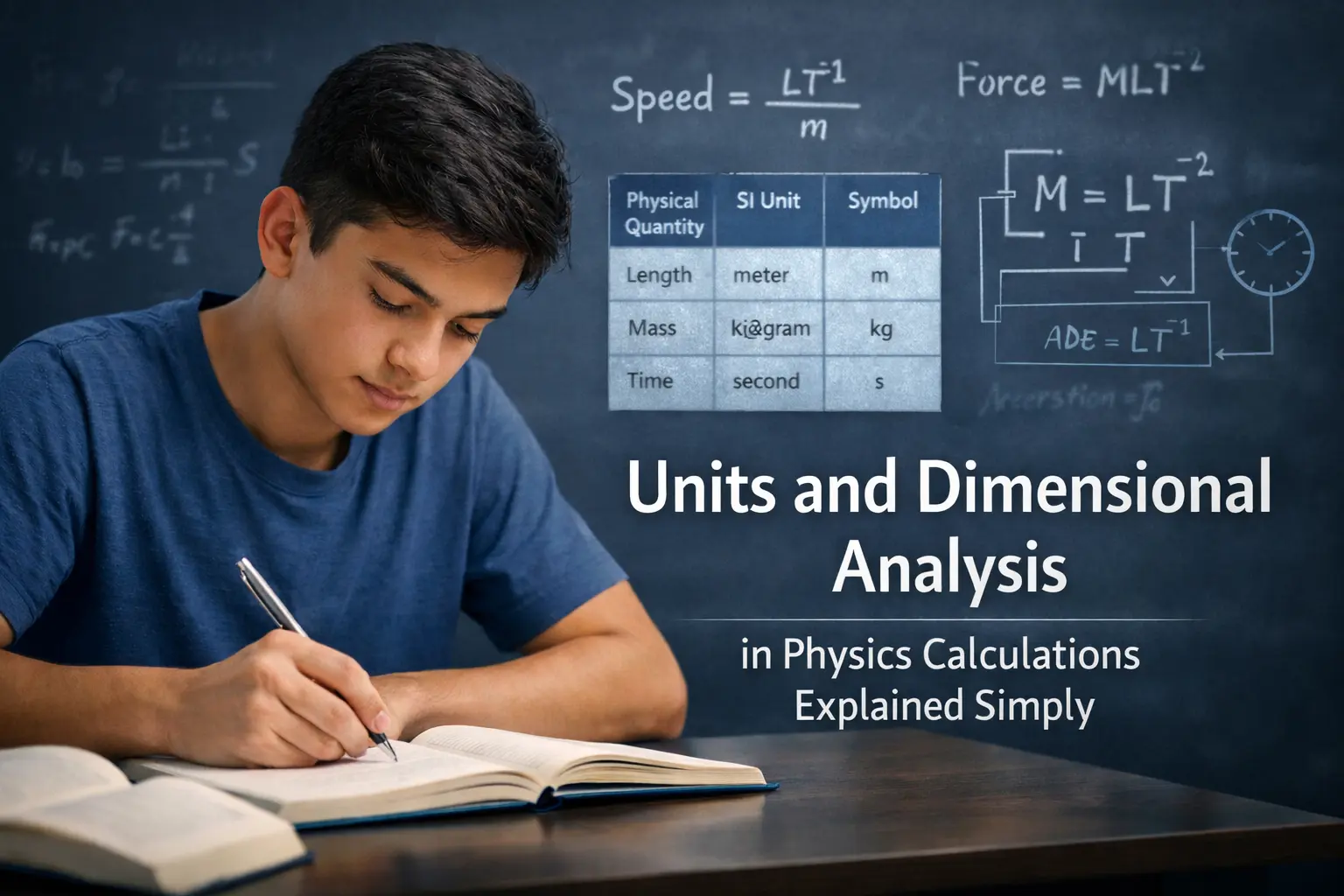
Units and dimensional analysis are the foundation of physics calculations, especially for Class 9 and 10 students. Many numerical mistakes don’t happen because formulas are wrong—but because units are ignored or dimensions are misunderstood.
This guide explains units and dimensional analysis in the simplest possible way, with clear examples and exam-focused explanations.
What Are Units in Physics?
Units are standard measurements used to express physical quantities.
Without units, numbers in physics have no meaning.
Examples:
- Length → meter (m)
- Time → second (s)
- Mass → kilogram (kg)
Physics calculations are only correct when values and units match properly.
SI Units Used in Physics (Class 9 & 10)
The SI (International System of Units) is used worldwide and must be used in exams.
| Physical Quantity | SI Unit | Symbol |
|---|---|---|
| Length | meter | m |
| Mass | kilogram | kg |
| Time | second | s |
What Is Dimensional Analysis?
Dimensional analysis is a method to check whether a physics formula is correct by comparing dimensions on both sides of the equation.
Every physical quantity can be written using three basic dimensions:
- Mass (M)
- Length (L)
- Time (T)
Dimensions of Common Physical Quantities
| Quantity | Formula | Dimensions |
|---|---|---|
| Speed | distance / time | LT⁻¹ |
| Acceleration | speed / time | LT⁻² |
| Force | mass × acceleration | MLT⁻² |
Why Is Dimensional Analysis Important?
Dimensional analysis helps students:
- Check whether a formula is correct
- Find unknown formulas
- Reduce mistakes in numericals
- Understand relationships between quantities
It is especially useful in derivations and conceptual questions.
How to Use Dimensional Analysis (Step by Step)
- Write the formula
- Replace quantities with their dimensions
- Simplify both sides
- Compare dimensions
If both sides match, the formula is dimensionally correct.
Example: Checking a Formula
Formula:
Speed = Distance / Time
Dimensions:
- Distance → L
- Time → T
So,
Speed = L / T = LT⁻¹
The formula is dimensionally correct.
Common Mistakes Students Make
- Mixing units (cm with m, hours with seconds)
- Skipping unit conversion
- Memorizing formulas without understanding dimensions
- Forgetting to write units in the final answer
Avoiding these mistakes can significantly improve exam scores.
Final Tip for Class 9 & 10 Students
Units and dimensional analysis are not just theory topics—they are tools that make physics numericals easier and safer. If you master units and dimensions early, complex physics problems become much simpler.
Understanding this chapter well builds a strong base for future physics topics.
FAQs
What Is Dimension and Unit Analysis in Physics?
Dimension and unit analysis in physics is a method used to understand physical quantities by expressing them in basic terms like mass, length, and time, and checking whether equations are correct. It helps students verify formulas, convert units, and avoid mistakes in numerical calculations.
What Is Dimensional Analysis in Simple Terms?
Dimensional analysis is a simple technique to check whether a physics formula makes sense by comparing the dimensions on both sides of an equation. If the dimensions are the same, the formula is likely correct; if not, the formula is wrong.
How Are Units and Dimensions Used in Physics?
Units and dimensions are used in physics to measure quantities correctly, perform accurate calculations, and ensure formulas are valid. Units tell us how much of a quantity we have, while dimensions show the nature of the quantity and help check the correctness of equations.
What Are the 1st, 2nd, 3rd, and 4th Dimensions?
In basic physics:
- 1st dimension refers to length (L)
- 2nd dimension refers to breadth or width, also a form of length
- 3rd dimension refers to height or depth, again a form of length
- 4th dimension is time (T), which is treated as a separate dimension in physics to describe motion and change
These dimensions help describe the position and motion of objects in space and time.