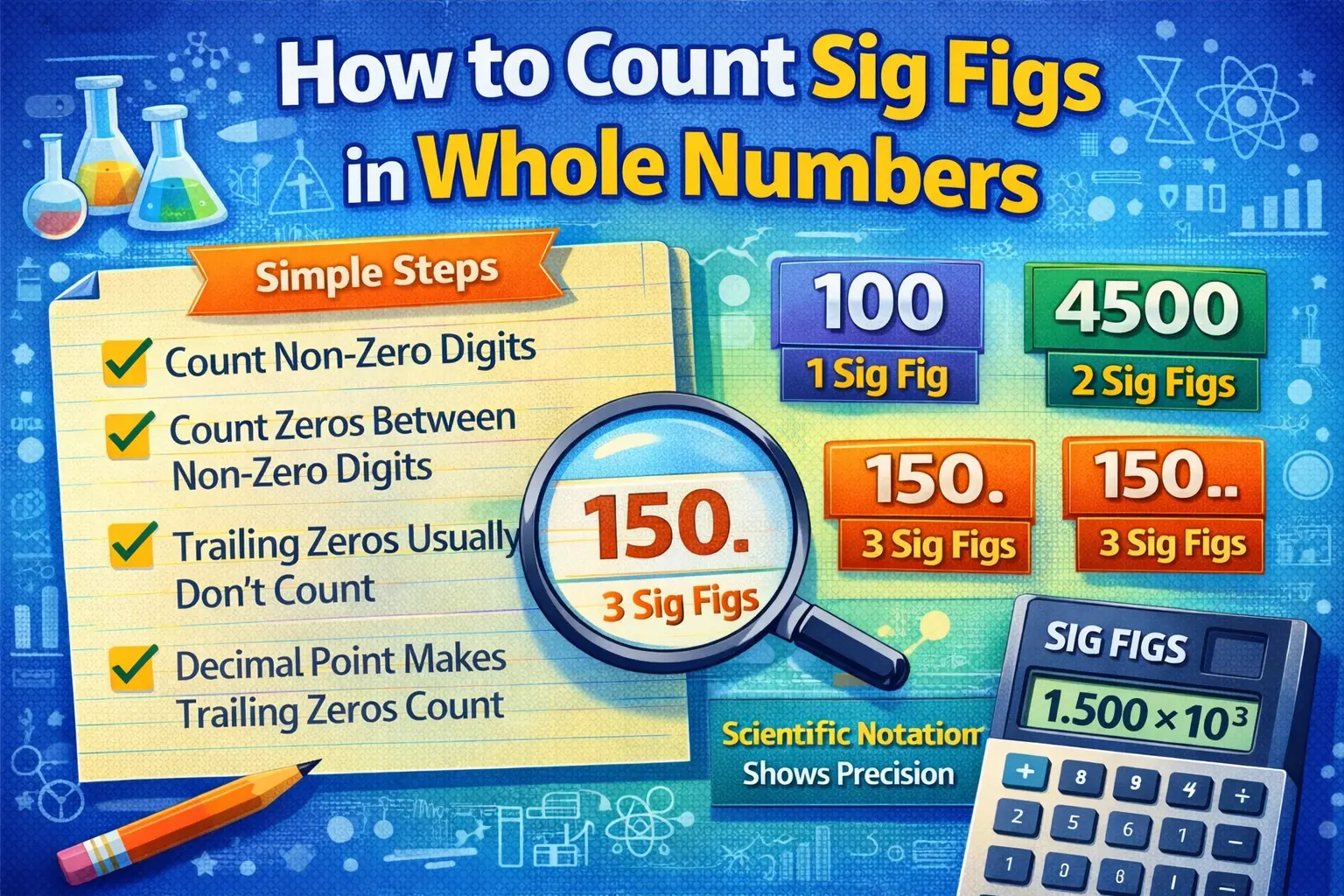
Counting significant figures in whole numbers is one of the most confusing parts of sig figs, especially because of trailing zeros. Many students assume all zeros are the same — but that’s not true.
In this guide, you’ll learn how to count sig figs in whole numbers step by step, using simple rules and clear examples.
What Are Whole Numbers in Significant Figures?
Whole numbers are numbers without a decimal point, such as:
- 25
- 400
- 1200
- 7000
When counting significant figures in whole numbers, the key question is:
Do the zeros show measurement precision, or are they just placeholders?
Rule 1: All Non-Zero Digits Are Significant
This rule is always true, no matter what type of number you’re dealing with.
Examples:
- 45 → 2 significant figures
- 907 → 3 significant figures
- 1234 → 4 significant figures
👉 Every digit from 1 to 9 is always counted.
Rule 2: Zeros Between Non-Zero Digits ARE Significant
If a zero appears between two non-zero digits, it is significant — even in whole numbers.
Examples:
- 101 → 3 significant figures
- 1002 → 4 significant figures
- 5006 → 4 significant figures
👉 These zeros show real measured precision.
Rule 3: Trailing Zeros in Whole Numbers Are Usually NOT Significant
Trailing zeros are zeros that appear at the end of a whole number.
Examples:
- 1500 → 2 significant figures
- 700 → 1 significant figure
- 42000 → 2 significant figures
👉 Without a decimal point, we cannot know whether these zeros were measured or just added for place value.
Rule 4: A Decimal Point Changes Everything
If a decimal point is added to a whole number, the trailing zeros become significant.
Compare:
- 150 → 2 significant figures
- → 3 significant figures
- 150.0 → 4 significant figures
👉 The decimal point tells us that the zeros are meaningful.
Rule 5: Use Scientific Notation to Avoid Confusion
Scientists often use scientific notation to clearly show how many significant figures a whole number has.
Examples:
- 1500 = 1.5 × 10³ → 2 significant figures
- 1500 = 1.500 × 10³ → 4 significant figures
👉 Only the digits in the coefficient are counted.
Step-by-Step Method to Count Sig Figs in Whole Numbers
Follow this simple process every time:
- Count all non-zero digits
- Count zeros between non-zero digits
- Ignore trailing zeros unless a decimal point is present
- Use scientific notation if precision is unclear
- The final count is the number of significant figures
Common Mistakes Students Make
- Counting all trailing zeros automatically
- Forgetting that whole numbers behave differently from decimals
- Ignoring the role of the decimal point
- Not using scientific notation when needed
Avoiding these mistakes can improve exam and lab accuracy.
Why Significant Figures in Whole Numbers Matter
Correct sig figs are important in:
- Chemistry and physics calculations
- Lab measurements
- Engineering values
- Scientific reports
Even if the math is correct, the wrong number of significant figures can make an answer incorrect.
Use an Online Sig Figs Calculator for Whole Numbers
Counting sig figs in whole numbers can be tricky, especially in exams.
Using an online significant figures calculator helps you:
- Instantly count sig figs
- Avoid zero-related mistakes
- Save time and reduce errors
Final Thoughts
Learning how to count sig figs in whole numbers becomes easy once you understand how zeros behave.
Remember: zeros at the end of a whole number usually don’t count unless a decimal point is present.
With practice — and by checking your answers when needed — you’ll master significant figures with confidence.
FAQs
How to count significant figures in whole numbers?
To count significant figures in whole numbers, count all non-zero digits and any zeros between non-zero digits. Trailing zeros at the end of a whole number are not significant unless a decimal point is present. If precision is unclear, scientific notation is used to show the correct number of significant figures.
How many significant figures are there in 0.310 × 10³?
The number 0.310 × 10³ has 3 significant figures.
Only the digits in the coefficient (0.310) are counted. The digits 3, 1, and the trailing zero after the decimal point are all significant.
How do you write 57.3997 correctly to 4 significant figures?
The number 57.3997 rounded to 4 significant figures is 57.40.
The first four significant digits are 5, 7, 3, and 9. The next digit (9) causes rounding up, and the trailing zero is included to show precision.
Does 7.0 have 2 sig figs?
Yes, 7.0 has 2 significant figures.
The digit 7 is significant, and the trailing zero after the decimal point is also significant because it indicates measurement precision.