Significant figures look simple at first—but in exams, small mistakes can cost easy marks. Most students don’t lose marks because they don’t know the rules. They lose marks because they apply the right rules in the wrong way.
Let’s go through the most common errors students make in significant figures and, more importantly, how you can avoid them.
1. Rounding Too Early in Calculations
❌ The Mistake
Many students round numbers in the middle of a calculation instead of at the end.
Example mistake:
2.456 × 3.2
Student rounds 2.456 → 2.46 first (wrong)
✅ How to Avoid It
Always:
- Perform the full calculation
- Round only the final answer
✔ Correct method:
2.456 × 3.2 = 7.8592 → 7.9
2. Mixing Up Decimal Places and Significant Figures
❌ The Mistake
Using significant figure rules for addition/subtraction or decimal place rules for multiplication/division.
This is one of the most common exam errors.
✅ How to Avoid It
Remember this simple rule:
- Addition & Subtraction → Decimal places matter
- Multiplication & Division → Significant figures matter
If you remember only this, you’ll avoid half the mistakes.
3. Counting Zeros Incorrectly
❌ The Mistake
Students often assume all zeros are significant, which is not true.
Examples:
- 0.0045 → ❌ counted as 4 sig figs
- 300 → ❌ counted as 3 sig figs
✅ How to Avoid It
Use this quick check:
- Leading zeros → not significant
- Zeros between numbers → significant
- Trailing zeros → significant only if a decimal point is present
✔ Correct:
- 0.0045 → 2 significant figures
- 300 → 1 significant figure
- 300.0 → 4 significant figures
4. Ignoring the Least Precise Number
❌ The Mistake
Students calculate correctly but forget to check which number limits precision.
Example:
12.45 + 3.2 = 15.65 ❌ written as final answer
✅ How to Avoid It
Always ask:
“Which number has the fewest decimal places or sig figs?”
✔ Correct final answer: 15.6
5. Forgetting That Whole Numbers Can Limit Precision
❌ The Mistake
Assuming whole numbers like 5 or 20 have infinite precision.
Example:
2.34 × 5 ❌ written as 11.70
✅ How to Avoid It
Whole numbers without decimals usually have 1 significant figure.
✔ Correct:
2.34 × 5 = 11.7 → 12
6. Writing Answers Without Showing Required Precision
❌ The Mistake
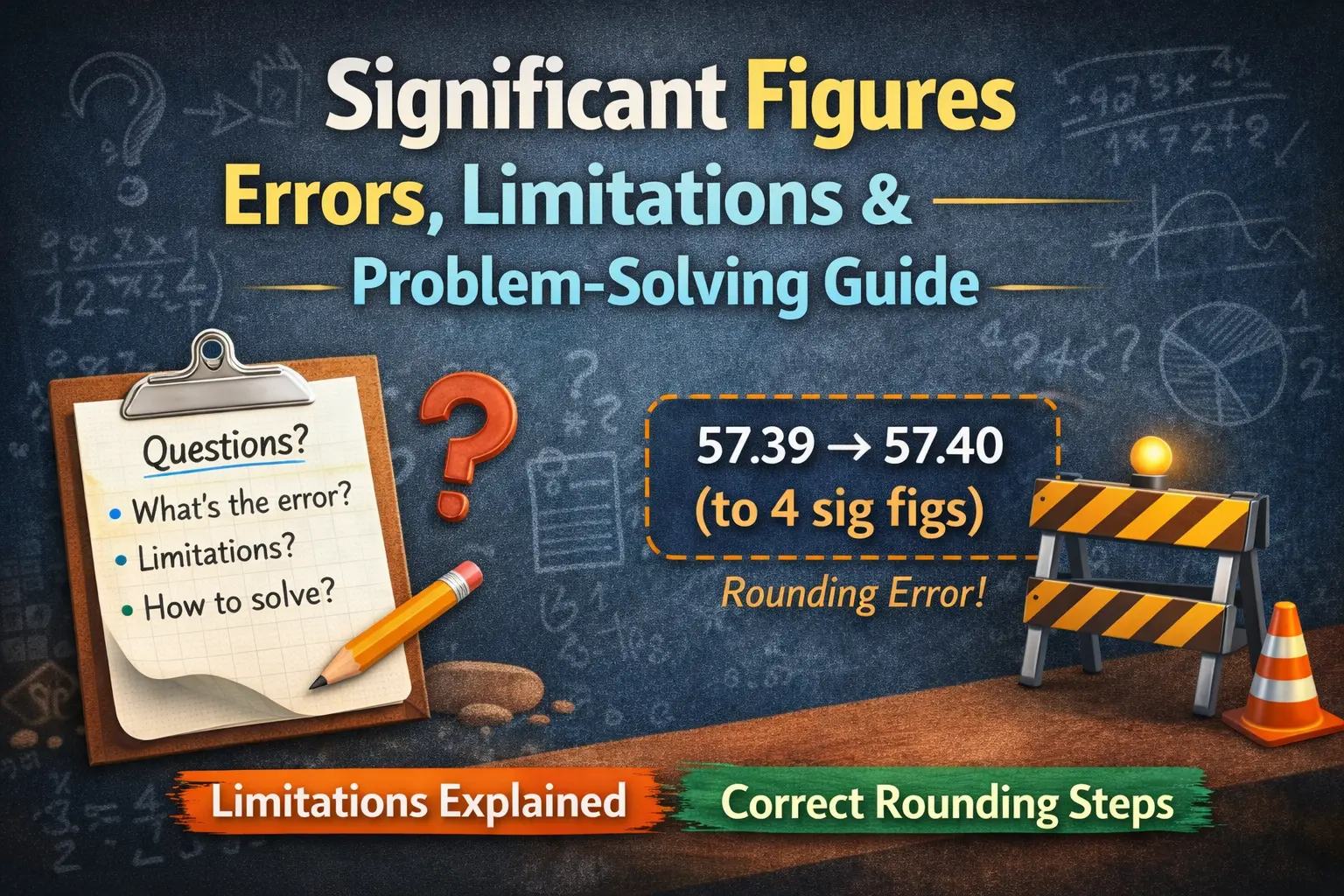
Writing 57.4 instead of 57.40 when 4 significant figures are required.
✅ How to Avoid It
Zeros at the end matter if they show precision.
✔ Correct:
- 57.40 → 4 significant figures
- 57.4 → 3 significant figures
7. Rounding in the Wrong Direction
❌ The Mistake
Rounding down when the next digit is 5 or greater.
Example:
6.749 → written as 6.74 ❌
✅ How to Avoid It
Basic rounding rule:
- If the next digit is 5 or more, round up
✔ Correct: 6.75
Final Exam-Saving Tip
Before submitting your answer, quickly check:
- Did I round only at the end?
- Did I apply the correct rule for the operation?
- Does my final answer match the required precision?
FAQs
What is the error of significant figures?
The error of significant figures is the small inaccuracy introduced when a number is rounded to a certain number of significant figures.
When you round a value, you slightly change the original measurement, which creates a rounding error.
How do you write 57.3997 correctly to 4 significant figures?
Step 1: Identify the first four significant digits → 5, 7, 3, 9
Step 2: Look at the next digit (9)
Since 9 is greater than or equal to 5, round up.
Answer: 57.40
(The zero is included to clearly show four significant figures.)
What are the limitations of significant figures?
Significant figures have some limitations, including:
- They do not show exact uncertainty in measurements
- Different rounding methods can give slightly different results
- They can hide small variations in precise data
- They are less accurate for very large or very small numbers
- They may cause cumulative errors in long calculations
Because of this, significant figures give an estimate of precision, not perfect accuracy.
How to solve problems with significant figures?
Follow this simple step-by-step method:
- Identify the significant figures in each number
- Perform the full calculation without rounding
- Decide which rule applies:
- Addition/Subtraction → decimal places
- Multiplication/Division → significant figures
- Round the final answer to the correct precision
- Double-check that the rounding matches the least precise value
This approach helps avoid most exam mistakes.