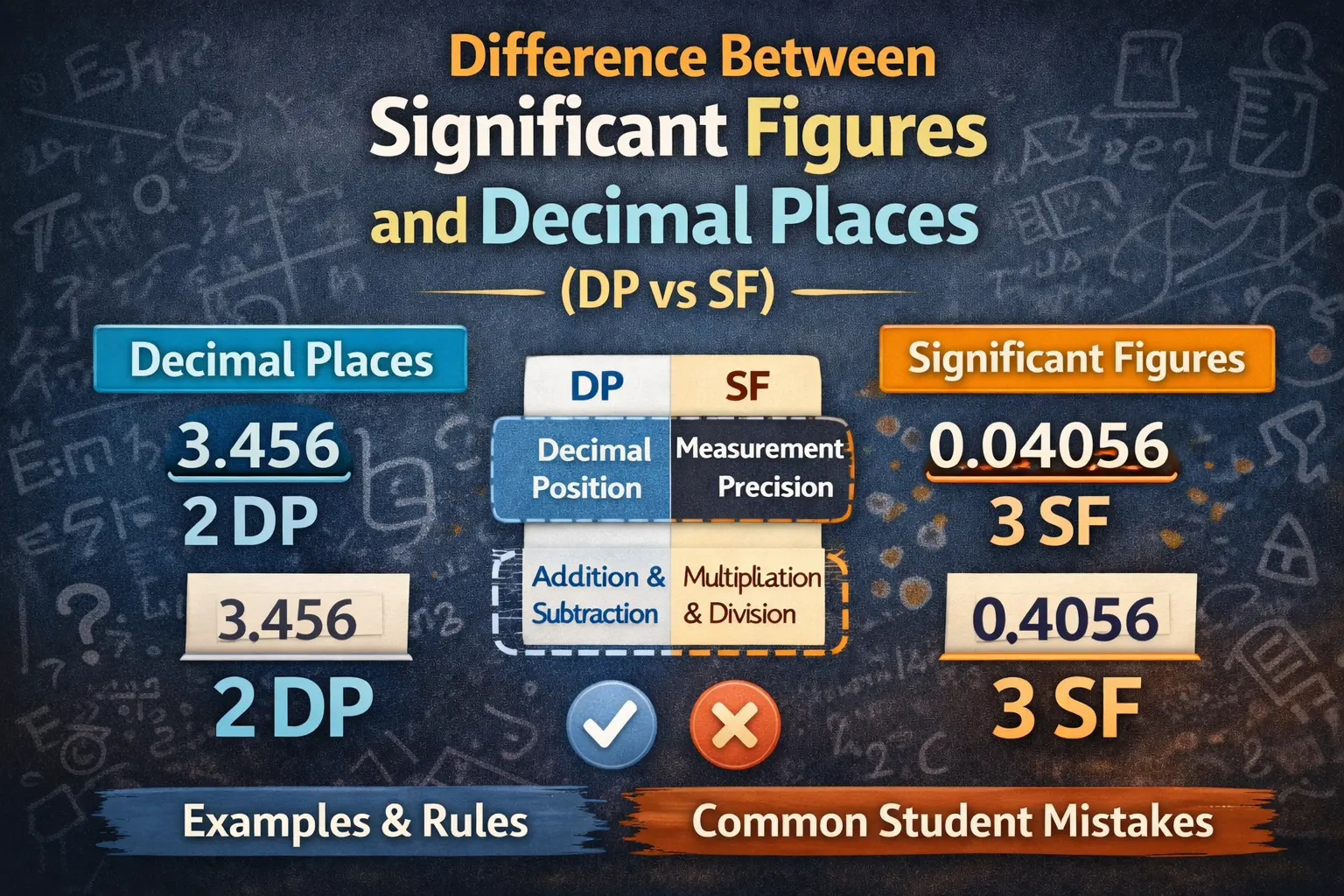
Students often mix up significant figures and decimal places, especially in exams. The rules look similar, but they are used in different situations. Once you understand the difference clearly, most calculation mistakes disappear.
Let’s explain it in a simple, exam-friendly way.
What Are Significant Figures?
Significant figures show how precise a number is, based on how it was measured.
They include:
- All non-zero digits
- Zeros between non-zero digits
- Trailing zeros only if a decimal point is present
Examples of Significant Figures
- 45.6 → 3 significant figures
- 0.0042 → 2 significant figures
- 300 → 1 significant figure
- 300.0 → 4 significant figures
Significant figures are mainly used in:
- Multiplication
- Division
- Most physics and chemistry calculations
What Are Decimal Places?
Decimal places refer to the number of digits after the decimal point, no matter how many digits come before it.
Examples of Decimal Places
- 12.45 → 2 decimal places
- 3.2 → 1 decimal place
- 100.0 → 1 decimal place
- 0.056 → 3 decimal places
Decimal places are mainly used in:
- Addition
- Subtraction
Key Difference (Most Important Rule)
👉 Significant figures deal with total precision
👉 Decimal places deal with alignment of decimals
If you remember this, you won’t confuse the rules.
Comparison Table (Quick Revision)
| Feature | Significant Figures | Decimal Places |
|---|---|---|
| What it shows | Precision of measurement | Position after decimal |
| Used in | Multiplication & Division | Addition & Subtraction |
| Counts | Meaningful digits | Digits after decimal |
| Common mistake | Counting zeros wrongly | Ignoring least decimals |
Worked Examples (Side by Side)
Example 1: Multiplication (Significant Figures)
2.4 × 3.567 = 8.5608
- 2.4 → 2 significant figures
- 3.567 → 4 significant figures
Final answer (2 sig figs):
8.6
Example 2: Addition (Decimal Places)
12.45 + 3.2 = 15.65
- 12.45 → 2 decimal places
- 3.2 → 1 decimal place
Final answer (1 decimal place):
15.6
Common Student Mistakes
- Using significant figures in addition/subtraction
- Using decimal places in multiplication/division
- Rounding numbers too early
- Ignoring the least precise value
Simple Memory Trick (Exam Saver)
- Multiply / Divide → Count significant figures
- Add / Subtract → Count decimal places
Write this on the side of your rough sheet in exams—it really helps.
Final Tip for Exams
If your final answer looks more precise than your given data, it is probably wrong. Precision should never increase during calculations.
FAQs
What is the difference between a significant figure and a decimal place?
A significant figure shows the precision of a number by counting all meaningful digits, including certain zeros.
A decimal place only counts how many digits appear after the decimal point, regardless of precision.
👉 Significant figures show accuracy, while decimal places show position after the decimal.
What is 0.4726 to 2 significant figures?
Step 1: First two significant digits → 4 and 7
Step 2: Look at the next digit (2)
Since 2 is less than 5, the number stays the same.
Answer: 0.47
What is the difference between DP and SF?
- DP (Decimal Places) count digits after the decimal point and are mainly used in addition and subtraction.
- SF (Significant Figures) count all meaningful digits and are mainly used in multiplication and division.
In short:
DP = decimal position
SF = measurement precision
How do you write 57.3997 correctly to 4 significant figures?
Step 1: First four significant digits → 5, 7, 3, 9
Step 2: Look at the next digit (9)
Since 9 is greater than or equal to 5, round up.
Answer: 57.40
(The zero is included to clearly show four significant figures.)