Many students learn the rules of significant figures but still lose marks because they don’t apply them correctly during calculations. Knowing the rules is only half the job — the real challenge is using them at the right time and in the right way.
In this guide, you’ll learn how to apply significant figures rules correctly, step by step, with clear examples and practical tips.
Step 1: Always Identify Significant Figures First
Before doing any calculation, first determine how many significant figures each number has.
Example:
- 2.40 → 3 significant figures
- 0.056 → 2 significant figures
- 1500 → 2 significant figures (no decimal point)
👉 Never skip this step. Most mistakes start here.
Step 2: Know Which Rule to Apply (Operation Matters)
The way you apply significant figures depends on the type of calculation.
There are two main cases:
- Multiplication & Division
- Addition & Subtraction
Using the wrong rule is a very common error.
Step 3: Applying Sig Figs in Multiplication & Division
For multiplication and division:
👉 The final answer must have the same number of significant figures as the number with the fewest sig figs.
Example:
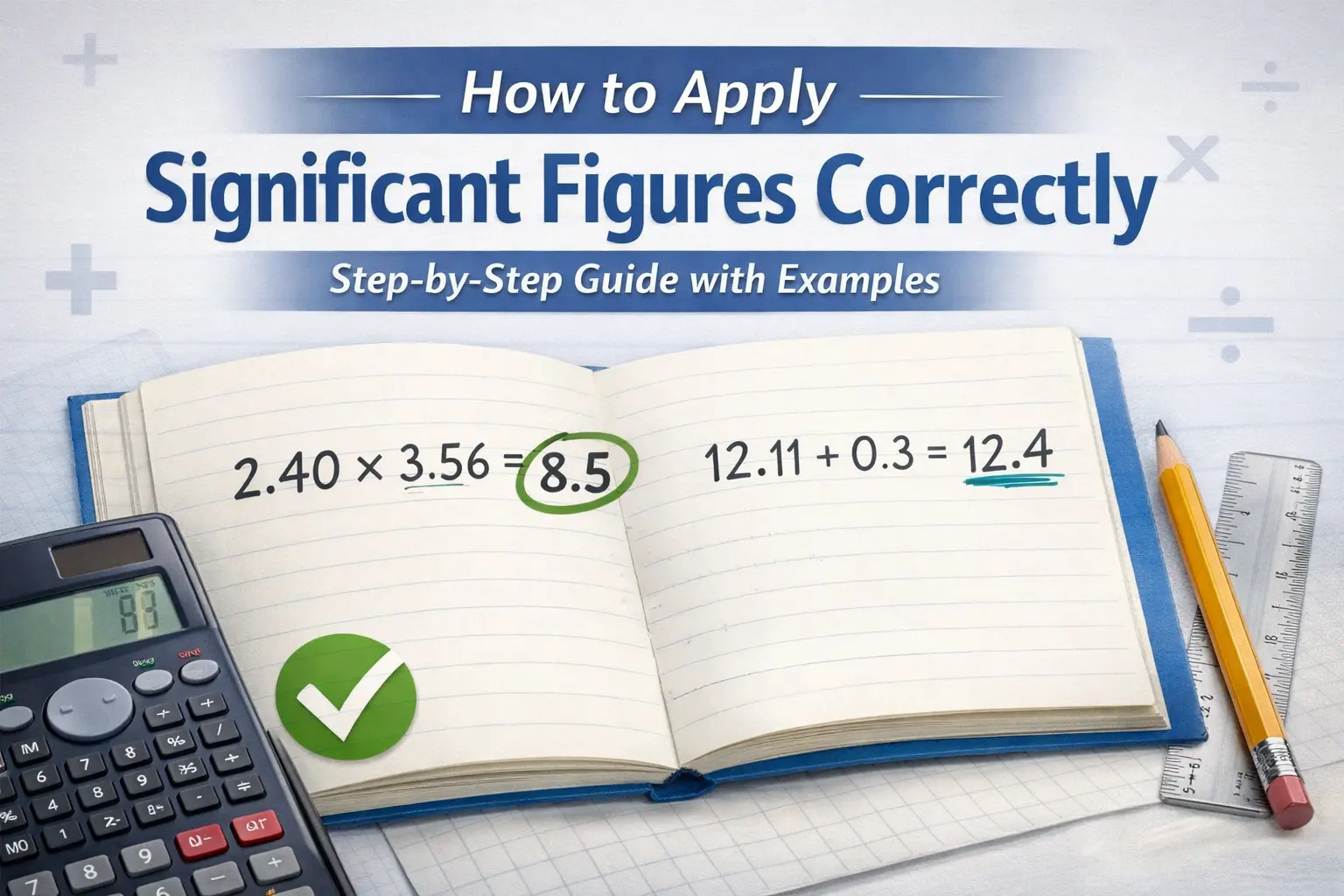
2.4 × 3.56
- 2.4 → 2 sig figs
- 3.56 → 3 sig figs
Calculation:
2.4 × 3.56 = 8.544
Round to 2 significant figures → 8.5
✅ Correct final answer: 8.5
Step 4: Applying Sig Figs in Addition & Subtraction
For addition and subtraction:
👉 Round based on decimal places, not significant figures.
Example:
12.11 + 0.3
- 12.11 → 2 decimal places
- 0.3 → 1 decimal place
Calculation:
12.11 + 0.3 = 12.41
Round to 1 decimal place → 12.4
✅ Correct final answer: 12.4
Step 5: Apply Rounding Only at the Final Step
One of the biggest mistakes students make is rounding too early.
Wrong approach:
- Rounding numbers in the middle of a calculation
Correct approach:
- Keep extra digits during calculations
- Round only the final answer
This prevents rounding errors from affecting your result.
Step 6: Handle Zeros Carefully
Zeros behave differently depending on their position.
Quick reminders:
- Leading zeros → Not significant
- Zeros between non-zero digits → Significant
- Trailing zeros with a decimal → Significant
- Trailing zeros without a decimal → Not significant
Example:
- 0.00450 → 3 significant figures
- 1500 → 2 significant figures
- 150.0 → 4 significant figures
Step 7: Use Scientific Notation When Precision Is Unclear
Scientific notation removes confusion about zeros.
Example:
- 1500 = 1.5 × 10³ → 2 sig figs
- 1500 = 1.500 × 10³ → 4 sig figs
👉 Only the digits in the coefficient matter.
Common Mistakes When Applying Significant Figures
- Rounding too early
- Using sig figs instead of decimal places in addition/subtraction
- Counting leading zeros
- Ignoring trailing zeros after a decimal
- Forgetting to check the smallest number of sig figs
Avoiding these mistakes can greatly improve exam accuracy.
Practical Checklist: Apply Sig Figs Correctly Every Time
Before submitting an answer, ask yourself:
- Did I count sig figs correctly?
- Am I multiplying/dividing or adding/subtracting?
- Did I apply the correct rule?
- Did I round only the final answer?
- Does my final result show the correct precision?
Use an Online Significant Figures Calculator
Even when you understand the rules, human error can still happen.
That’s why many students and professionals use an online significant figures calculator to double-check:
- Sig fig count
- Correct rounding
- Final precision
This is especially helpful in exams and lab work.
Final Thoughts
Applying significant figures correctly is about discipline and order, not memorization.
When you follow the steps in the correct sequence, significant figures become logical and predictable.
Practice regularly, apply the rules carefully, and always verify when possible.
FAQs
How to properly use significant figures?
To properly use significant figures, first determine how many significant figures each number has. Perform the calculation, then round the final answer to match the number with the fewest significant figures. For addition and subtraction, round based on decimal places, not significant figures.
How do you write 0.416 666 667 correctly to 3 significant figures?
The number 0.416 666 667 rounded to 3 significant figures is 0.417.
The first three significant digits are 4, 1, and 6. The next digit is 6, so the last digit rounds up.
What is 432.75 rounded to 2 significant figures?
The number 432.75 rounded to 2 significant figures is 430.
The first two significant digits are 4 and 3. The next digit (2) is less than 5, so no rounding up is needed. The remaining digits are replaced with zeros to keep the correct place value.
What is 0.9999 to 3 significant figures?
The number 0.9999 rounded to 3 significant figures is 1.00.
The first three significant digits are 9, 9, and 9. The next digit causes the number to round up, and 1.00 keeps three significant figures by including two decimal zeros.