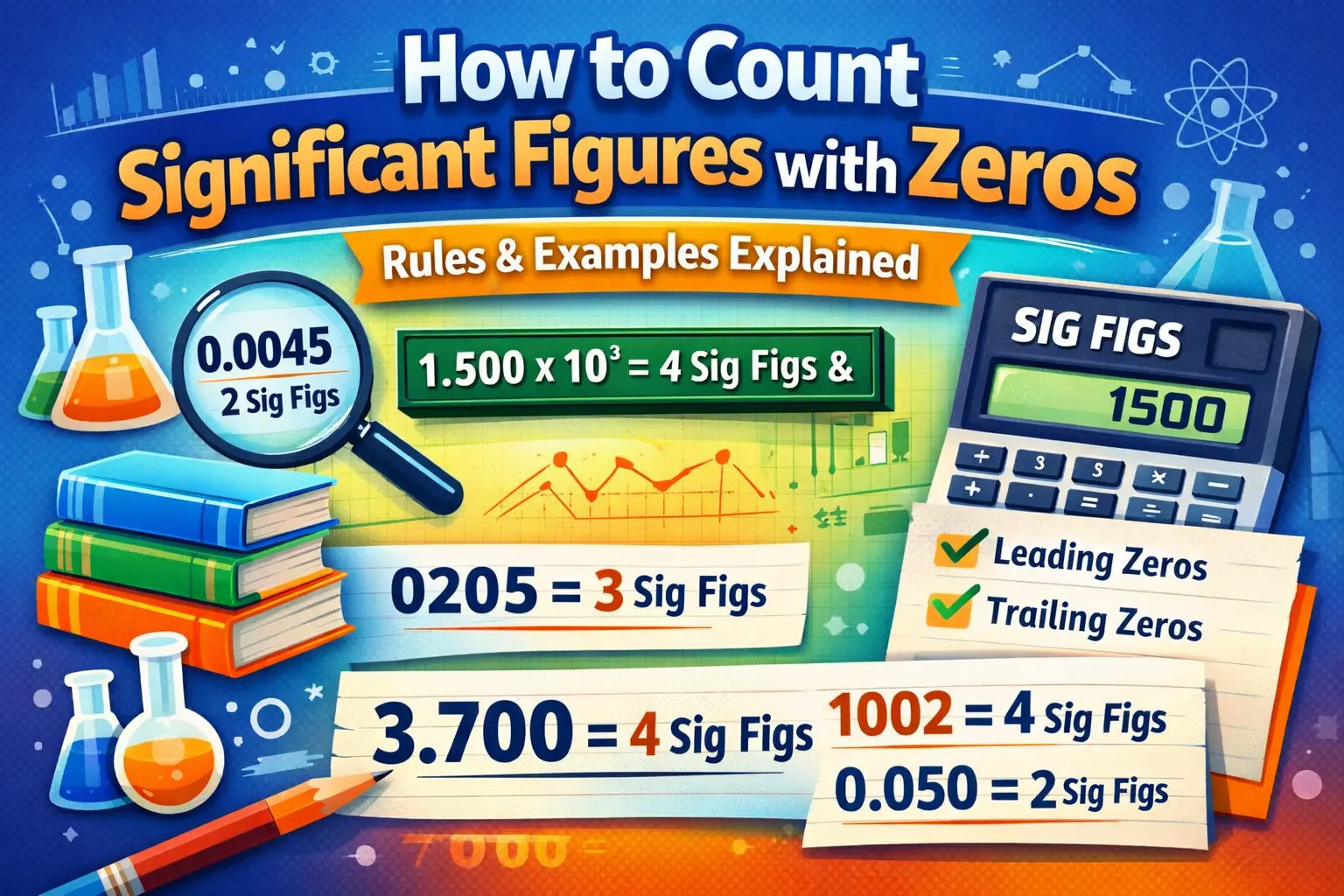
Counting significant figures becomes confusing for many students when zeros appear in a number. Some zeros are counted, while others are not — and this is where most mistakes happen. In this guide, you’ll learn how to count significant figures with zeros step by step, using clear rules and easy examples.
What Are Significant Figures?
Significant figures are the digits in a number that carry meaningful information about its precision. They include all certain digits and the first uncertain digit in a measurement.
In simple words, significant figures tell us how accurate a number really is.
How Do Zeros Affect Significant Figures?
Zeros do not always behave the same way.
Whether a zero is significant or not depends on where it appears in the number.
To avoid confusion, let’s break this into simple rules.
Rule 1: Leading Zeros Are NOT Significant
Leading zeros are the zeros that come before the first non-zero digit.
Example:
- 0.0045 → 2 significant figures
- 0.00078 → 2 significant figures
👉 These zeros only help show the position of the decimal point.
They do not add any precision.
Rule 2: Zeros Between Non-Zero Digits ARE Significant
Any zero that appears between two non-zero digits is always counted.
Example:
- 101 → 3 significant figures
- 1002 → 4 significant figures
- 2.05 → 3 significant figures
👉 These zeros are meaningful and indicate measured precision.
Rule 3: Trailing Zeros in Decimal Numbers ARE Significant
When zeros come after a non-zero digit and after a decimal point, they are significant.
Example:
- 2.50 → 3 significant figures
- 4.200 → 4 significant figures
- 0.0300 → 3 significant figures
👉 These zeros show that the measurement was taken carefully.
Rule 4: Trailing Zeros in Whole Numbers Are Usually NOT Significant
Zeros at the end of a whole number without a decimal point are generally not counted, unless stated otherwise.
Example:
- 1500 → 2 significant figures
- 7000 → 1 significant figure
👉 Without a decimal point, we can’t be sure whether those zeros were measured or just placeholders.
How to Handle Confusing Cases (Scientific Notation)
Scientific notation removes all confusion about zeros.
Example:
- 1500 = 1.5 × 10³ → 2 significant figures
- 1500 = 1.500 × 10³ → 4 significant figures
👉 Scientific notation clearly shows how many digits are significant.
Step-by-Step Method to Count Significant Figures With Zeros
- Ignore all leading zeros
- Count all non-zero digits
- Count zeros between non-zero digits
- Count trailing zeros only if a decimal point is present
- Use scientific notation when precision is unclear
Common Mistakes Students Make
- Counting leading zeros as significant
- Ignoring zeros between digits
- Assuming all trailing zeros are significant
- Not using scientific notation when needed
Avoiding these mistakes can dramatically improve accuracy in exams and lab work.
Why Counting Significant Figures Correctly Matters
Correct significant figures are essential in:
- Chemistry calculations
- Physics measurements
- Lab reports
- Scientific research
- Engineering and medical data
Using the wrong number of significant figures can make an answer technically incorrect, even if the calculation is right.
Use an Online Significant Figures Calculator to Avoid Errors
Manually counting significant figures with zeros can be tricky, especially for long or decimal numbers. To save time and avoid mistakes, you can use a free online significant figures calculator.
It instantly:
- Counts significant figures
- Handles zeros correctly
- Works for decimals and scientific notation
This is especially useful for students, teachers, and lab work.
Final Thoughts
Zeros don’t always mean the same thing in significant figures.
Once you understand where the zero appears, counting becomes simple and logical.
If you practice these rules and double-check your answers using a reliable calculator, you’ll never struggle with significant figures again.
FAQs
How to find significant figures with zeros?
To find significant figures with zeros, first check where the zeros appear.
Leading zeros (before the first non-zero digit) are not significant.
Zeros between non-zero digits are significant.
Trailing zeros are significant only if a decimal point is present.
Using these rules helps you accurately count significant figures in any number.
How many sig figs does .002 have?
The number 0.002 has 1 significant figure.
All the zeros before the digit 2 are leading zeros, which are not counted as significant. Only the digit 2 is significant.
Does 0.100 have 3 sig figs?
Yes, 0.100 has 3 significant figures.
The leading zero before the decimal is not significant, but the two zeros after the decimal point are trailing zeros and are significant because they show precision in the measurement.
How many significant figures are there in 0.310 × 10³?
The number 0.310 × 10³ has 3 significant figures.
In scientific notation, only the digits in the coefficient (0.310) are counted. The digits 3, 1, and the trailing zero after the decimal are all significant.