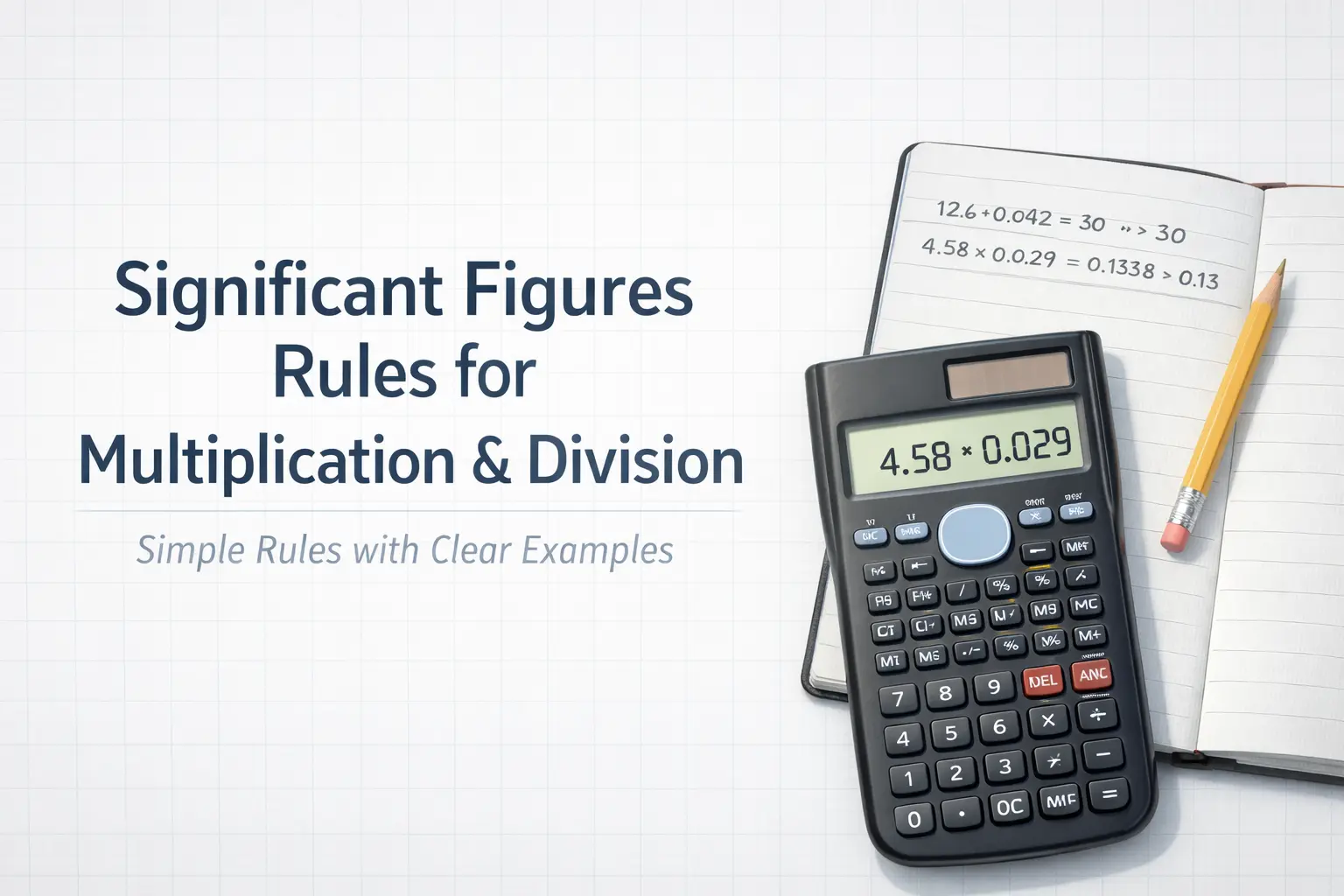
When you multiply or divide numbers in science, the final answer must reflect the least precise measurement. This is where significant figures rules are applied.
Many students lose marks by applying addition/subtraction rules instead of multiplication/division rules. Let’s clear this confusion step by step.
The Main Rule (Most Important)
In multiplication and division, the final answer must have the same number of significant figures as the number with the fewest significant figures.
That’s it. Everything else follows from this rule.
Step-by-Step Method (Always Follow This)
Step 1: Count significant figures in each number
Step 2: Identify the smallest number of significant figures
Step 3: Perform the calculation normally
Step 4: Round the final answer to that number of significant figures
Example 1: Multiplication
Calculate:
2.4 × 3.56
Step 1: Count significant figures
- 2.4 → 2 significant figures
- 3.56 → 3 significant figures
Step 2: Choose the smallest
- Smallest = 2 significant figures
Step 3: Calculate
- 2.4 × 3.56 = 8.544
Step 4: Round to 2 significant figures
✅ Final Answer:
8.5
Example 2: Division
Calculate:
12.6 ÷ 0.42
Step 1: Count significant figures
- 12.6 → 3 significant figures
- 0.42 → 2 significant figures
Step 2: Choose the smallest
- Smallest = 2 significant figures
Step 3: Calculate
- 12.6 ÷ 0.42 = 30
Step 4: Express with correct sig figs
✅ Final Answer:
30 (written as 3.0 × 10¹ if clarity is needed)
Important Notes Students Often Miss
- Do not round numbers in the middle of a calculation
- Keep extra digits until the final step
- The decimal position does not matter in multiplication/division
- Only the number of significant figures matters
Common Mistake (Avoid This!)
❌ Using decimal place rules
❌ Rounding too early
❌ Counting trailing zeros incorrectly
✔ Always count significant figures before calculating
Quick Practice Question
Calculate:
5.03 × 0.20
Solution:
- 5.03 → 3 significant figures
- 0.20 → 2 significant figures
- Result → rounded to 2 significant figures
Correct answer: 1.0
FAQs
What Are the Rules for Significant Figures for Multiplication and Division?
Answer:
For multiplication and division, the final answer must have the same number of significant figures as the number with the fewest significant figures in the calculation. You should perform the calculation first and round only the final result to the correct number of significant figures.
When Multiplying 3.24 by 0.006, How Many Significant Figures Should the Result Have?
Answer:
First, count the significant figures in each number:
- 3.24 → 3 significant figures
- 0.006 → 1 significant figure
Since 0.006 has the fewest significant figures, the final result must have:
✅ 1 significant figure
What Is the Rule for Multiplication and Division?
Answer:
The rule for multiplication and division is simple:
The answer must be rounded to the same number of significant figures as the value with the least significant figures.
Decimal places do not matter in these operations — only the number of significant figures matters.
What Are the 5 Rules for Significant Figures?
Answer:
The five main rules for significant figures are:
- All non-zero digits are significant.
Example: 47 → 2 significant figures - Zeros between non-zero digits are significant.
Example: 1002 → 4 significant figures - Leading zeros are not significant.
Example: 0.0045 → 2 significant figures - Trailing zeros are significant only if a decimal point is present.
Example: 2.50 → 3 significant figures
Example: 250 → 2 significant figures - Exact numbers have infinite significant figures.
Example: 1 dozen = 12, counted objects